I. Introduction
A. Importance of English language learning in elementary school.
B. Overview of the English language curriculum for Grade 3, Semester 2.
C. Purpose of the article: providing insights into the types of questions and topics covered in the Grade 3 Semester 2 English exam.
II. Exam Structure and Format
A. General structure (e.g., multiple choice, fill in the blanks, matching, short answer, essay).
B. Time allocation for each section.
C. Marking scheme and grading system.
III. Topics Covered in the Exam
A. Vocabulary: Focus on specific vocabulary related to the topics taught in the semester. Provide examples.
B. Grammar: Highlight key grammatical concepts tested, such as tenses (simple present, simple past), plurals, articles, pronouns, prepositions. Provide examples.
C. Reading Comprehension: Explain the types of passages used (e.g., short stories, factual texts). Mention question types (e.g., literal comprehension, inferential comprehension).
D. Writing: Describe the types of writing tasks (e.g., short paragraphs, simple stories, sentence writing). Provide examples.
E. Listening Comprehension (if applicable): Explain the format and types of listening tasks (e.g., following instructions, identifying sounds, understanding short dialogues).
IV. Sample Questions and Answers
A. Vocabulary: Provide multiple-choice and fill-in-the-blank questions with answers.
B. Grammar: Provide examples of sentence correction, multiple choice questions on grammar rules.
C. Reading Comprehension: Include a short passage followed by comprehension questions. Provide answers with explanations.
D. Writing: Provide a simple writing prompt with an example of a good response.
E. Listening Comprehension (if applicable): Provide example scenarios and questions.
V. Tips and Strategies for Success
A. Importance of regular study and practice.
B. Effective study techniques (e.g., flashcards, quizzes, group study).
C. Time management during the exam.
D. Strategies for tackling different question types.
E. Importance of understanding instructions.
VI. Conclusion
A. Recap of the key topics and question types.
B. Emphasis on the importance of consistent effort and practice.
C. Encouragement for students to approach the exam with confidence.
I. Introduction
Learning English is crucial for young learners in today’s globalized world. It opens doors to communication, knowledge, and future opportunities. The English language curriculum for Grade 3, Semester 2, builds upon the foundation established in the first semester, focusing on expanding vocabulary, reinforcing grammatical concepts, and developing reading and writing skills. This article aims to provide a comprehensive overview of the types of questions and topics typically included in a Grade 3, Semester 2 English language examination, enabling students to better prepare and approach the exam with confidence.
II. Exam Structure and Format
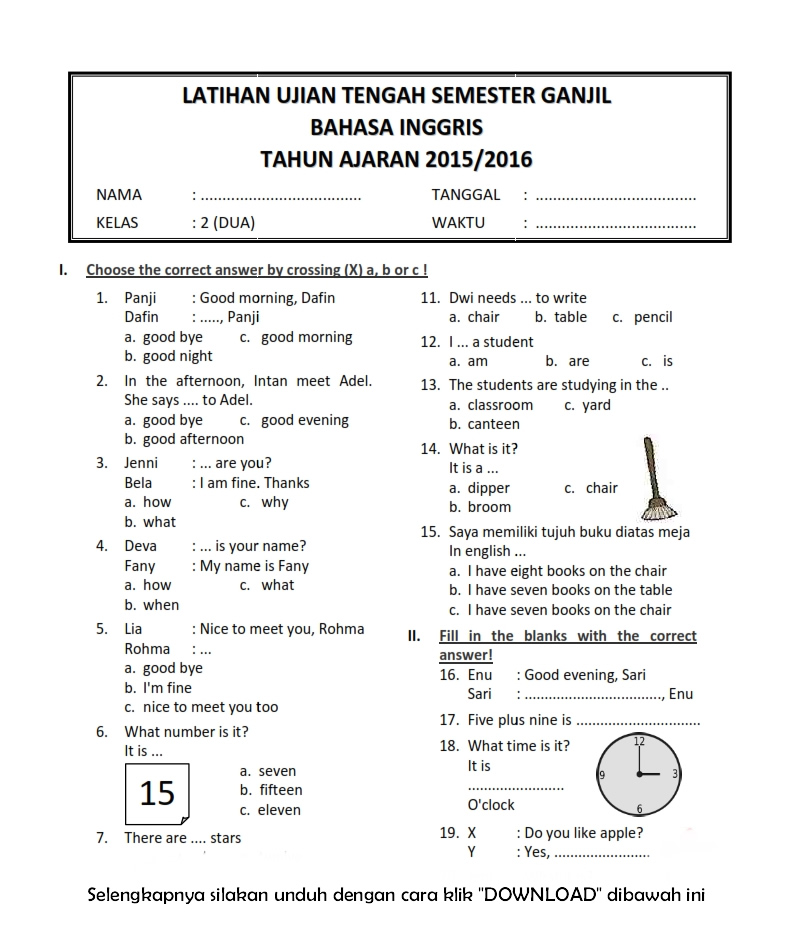
The Grade 3, Semester 2 English exam usually consists of several sections, assessing different aspects of language proficiency. A typical format might include:
- Multiple Choice Questions (MCQs): These assess vocabulary, grammar, and reading comprehension. Each question presents several options, with only one correct answer.
- Fill in the Blanks: These test vocabulary and grammar understanding, requiring students to complete sentences with appropriate words.
- Matching: Students match words, phrases, or pictures to their corresponding definitions or descriptions.
- Short Answer Questions: These require concise, factual answers, often testing reading comprehension or grammatical understanding.
- Writing: This section evaluates the students’ ability to write short paragraphs or simple stories based on given prompts.
The time allocated for each section will vary depending on the specific exam, but generally, there’s a time limit for the entire exam, usually around 60-90 minutes. The marking scheme will typically assign points to each question based on its difficulty and importance. The final grade is calculated based on the total points obtained.
III. Topics Covered in the Exam
The specific topics covered will depend on the curriculum followed by the school. However, some common themes include:
A. Vocabulary: Students will be tested on vocabulary related to everyday life, familiar objects, animals, actions, feelings, and topics covered in their textbooks. Examples include words related to family members (mother, father, sister), colors (red, blue, green), animals (cat, dog, bird), actions (run, jump, sing), and feelings (happy, sad, angry).
B. Grammar: Key grammatical concepts assessed include:
- Simple Present Tense: Describing habitual actions (e.g., "I eat breakfast every morning").
- Simple Past Tense: Describing completed actions (e.g., "I went to the park yesterday").
- Plural Nouns: Forming plural nouns (e.g., cat/cats, dog/dogs).
- Articles (a, an, the): Correct usage of articles.
- Pronouns (I, you, he, she, it, we, they): Correct pronoun usage.
- Prepositions (on, in, at, to, from): Correct preposition usage in sentences.
C. Reading Comprehension: Students will be presented with short stories, simple poems, or factual texts. Questions will test their understanding of the text, including:
- Literal Comprehension: Identifying information explicitly stated in the text.
- Inferential Comprehension: Drawing conclusions based on information in the text.
D. Writing: This section may involve tasks such as:
- Sentence Writing: Writing complete and grammatically correct sentences.
- Paragraph Writing: Writing short paragraphs on given topics, focusing on sentence structure and coherence.
- Story Writing: Writing simple stories based on given prompts or pictures.
E. Listening Comprehension: Some exams may include a listening comprehension section, requiring students to listen to short dialogues or instructions and answer questions based on what they heard. This might involve identifying sounds, understanding simple instructions, or answering questions about a short story read aloud.
IV. Sample Questions and Answers
A. Vocabulary:
- Multiple Choice: What is the opposite of "happy"? a) sad b) angry c) tired d) hungry (Answer: a) sad)
- Fill in the Blanks: The cat sat on the __. (Answer: mat/chair/sofa etc.)
B. Grammar:
- Sentence Correction: Correct the sentence: "She go to school every day." (Answer: She goes to school every day.)
- Multiple Choice: Which sentence uses the correct past tense? a) I see a bird. b) I saw a bird. c) I am seeing a bird. (Answer: b) I saw a bird.)
C. Reading Comprehension:
(Passage: A little bird flew to a tree. It sang a sweet song. A cat watched the bird.)
- Question: What did the bird do? (Answer: The bird flew to a tree and sang a sweet song.)
- Question: What animal watched the bird? (Answer: A cat.)
D. Writing:
- Prompt: Write a short paragraph about your favorite pet.
(Example Response: My favorite pet is my dog, Max. He is a playful golden retriever. Max loves to run and fetch balls. He is very friendly and makes me happy.)
E. Listening Comprehension (Example):
(Scenario: The teacher plays a recording of sounds: a dog barking, a cat meowing, a bird singing.)
- Question: What sound did you hear first? (Answer: A dog barking.)
V. Tips and Strategies for Success
- Regular Study: Consistent study throughout the semester is key to success. Don’t cram!
- Practice: Regularly practice different question types to build confidence and identify areas needing improvement. Use flashcards for vocabulary and grammar rules.
- Time Management: During the exam, allocate time wisely to each section. Don’t spend too long on any one question.
- Understand Instructions: Carefully read the instructions for each question before attempting it.
- Effective Study Techniques: Use a variety of methods, including flashcards, quizzes, and group study sessions. Make learning fun!
- Seek Clarification: If you don’t understand something, ask your teacher for help.
VI. Conclusion
The Grade 3, Semester 2 English exam assesses a range of skills, including vocabulary, grammar, reading comprehension, and writing. By understanding the exam structure, topics covered, and employing effective study strategies, students can significantly improve their performance and approach the exam with confidence. Remember, consistent effort and practice are the keys to success. Good luck!